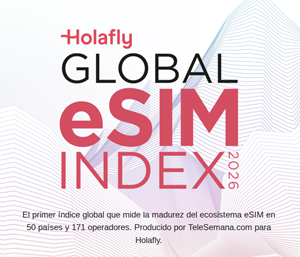
Holafly and TeleSemana.com launch the Holafly Global eSIM Index 2026, the first comprehensive benchmark measuring eSIM readiness across 50 markets
13 de maio de 2026
DUBLIN, May 13, 2026 (GLOBE NEWSWIRE) — Holafly, the global leader in travel eSIMs, today announced the launch of the Holafly Global eSIM Index 2026a first-of-its-kind study that evaluates the commercial readiness of eSIM technology across 50 markets and 168 mobile network operators worldwide.
Developed in collaboration with TeleSemana.com, one of Latin Americas leading telecommunications industry publications, the Index offers a structured, data-driven view of how eSIM is deployed, experienced, and constrained across regions. It brings together operator-level data, country-level variables, qualitative assessment, and a regulatory penalty mechanism into a single 0100 scoring framework.
The findings clearly demonstrate a decisive shift in the industry: eSIM is no longer a technology in development, but a globally deployed capability. What differentiates markets today is not technical readiness, but the structural conditions that enable or limit adoption, including device availability, regulatory frameworks, and the quality of the user experience.
The United States ranks first globally with a score of 90.2, followed by Estonia and the United Kingdom, while markets such as Sudan, India, and Liberia reflect the structural barriers that continue to limit adoption. Notably, the Index identifies regulatory intervention as a decisive factor, with specific markets applying restrictions that materially impact the scalability of eSIM services.
The central conclusion is that eSIM adoption is no longer constrained by technology, but by market design. Where regulation enables digital activation, devices are widely available, and operators deliver seamless experiences, adoption scales rapidly. Where these conditions are not aligned, growth remains structurally limited.
eSIM has already moved beyond being an emerging technology. What will shape the next phase of adoption is how effectively markets enable seamless digital access for users. The countries leading this transition are not necessarily those with the largest telecom infrastructure, but those creating frictionless experiences that match the expectations of todays global travelers, said Chris Hills, VP of Carriers & Operations at Holafly.
From a methodology standpoint, the Index evaluates five core dimensions: market readiness, activation and support, adoption and competition, regulatory environment, and expert assessment. A dedicated penalty mechanism captures the impact of markets that restrict access to international eSIM providers, ensuring that the Index reflects not only operator capability but also real user accessibility.
As travelers demand more flexible, borderless, and immediate ways to stay online, travel eSIM providers are becoming a key driver of change across the industry. By removing many of the traditional barriers associated with physical SIM cards and complex activation processes, eSIM solutions are redefining how people access mobile services abroad and accelerating the transition toward a more seamless global travel experience.
The Holafly Global eSIM Index 2026 sets a new reference framework for operators, regulators, and industry stakeholders, delivering a consistent benchmark that clarifies where adoption is already tangible, where it remains constrained, and where future growth is most likely to surface.
Holafly and TeleSemana.com launch the Holafly Global eSIM Index 2026
Holafly and TeleSemana.com launch the Holafly Global eSIM Index 2026, the first comprehensive benchmark of eSIM readiness across 50 markets
A OESP nao e(sao) responsavel(is) por erros, incorrecoes, atrasos ou quaisquer decisoes tomadas por seus clientes com base nos Conteudos ora disponibilizados, bem como tais Conteudos nao representam a opiniao da OESP e sao de inteira responsabilidade da GlobeNewswire